
 English
 Español
 русский
 Français
 عربى
عربىIn demanding label applications, the material must do more than carry information. It must resist tearing, remain stable during handling and processing, maintain visual quality, and perform reliably when exposed to moisture, oil, heat, chemicals, and abrasion. Gloss silver PET self-adhesive label material with a functional top coating is engineered for exactly these expectations. It combines the strength and dimensional stability of polyester film with a bright metallic silver appearance and a specially prepared surface designed to support high-quality label conversion and printing.
This product belongs to the PET adhesive film category and is suitable for a broad range of resistant labels used in electrical appliances, mechanical products, cosmetics, bathroom supplies, jewelry, industrial packaging, product identification, warning labels, and many other applications. Compared with conventional paper labels or ordinary uncoated film labels, gloss silver PET label material offers a more premium appearance, stronger physical durability, better resistance to moisture and oils, and higher suitability for environments where labels must remain legible and firmly attached over time.
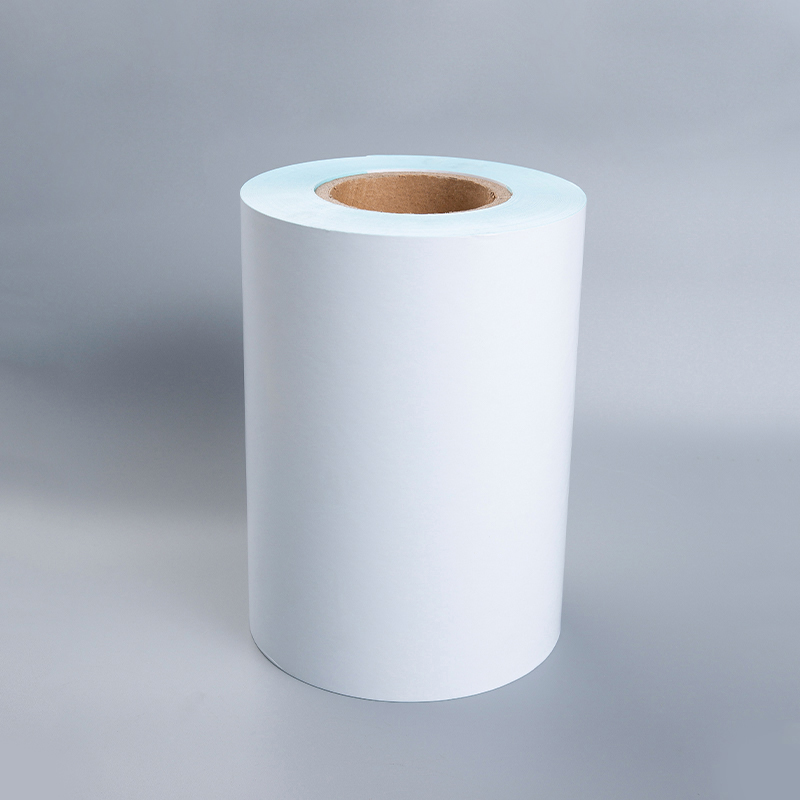
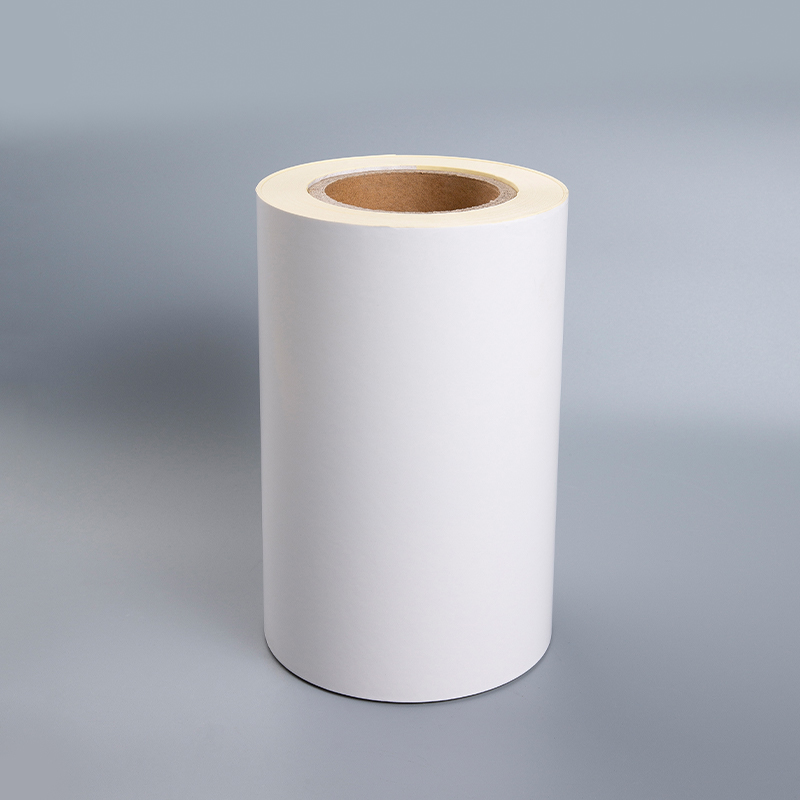
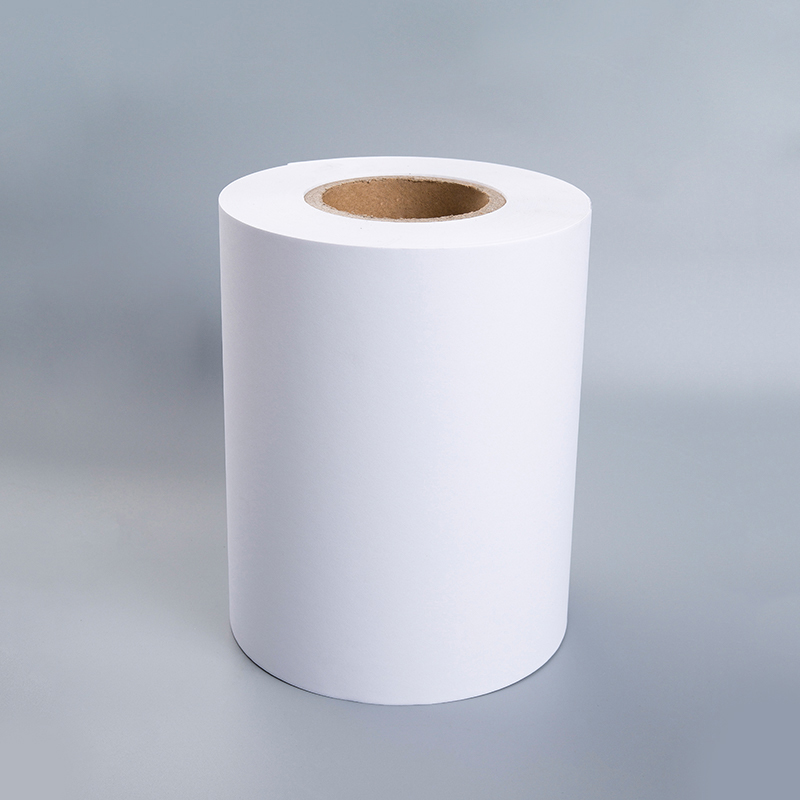
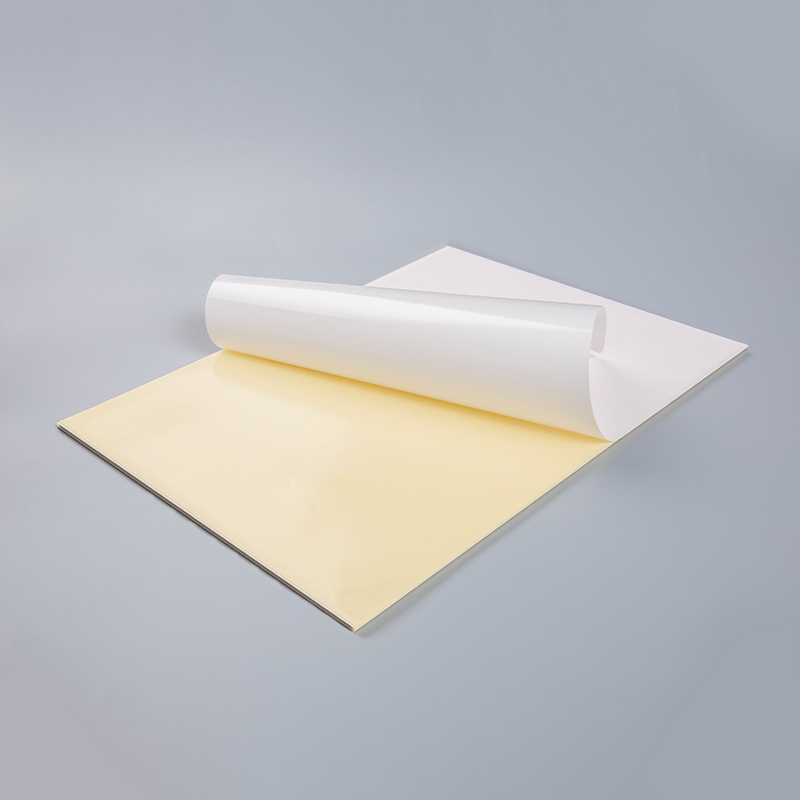
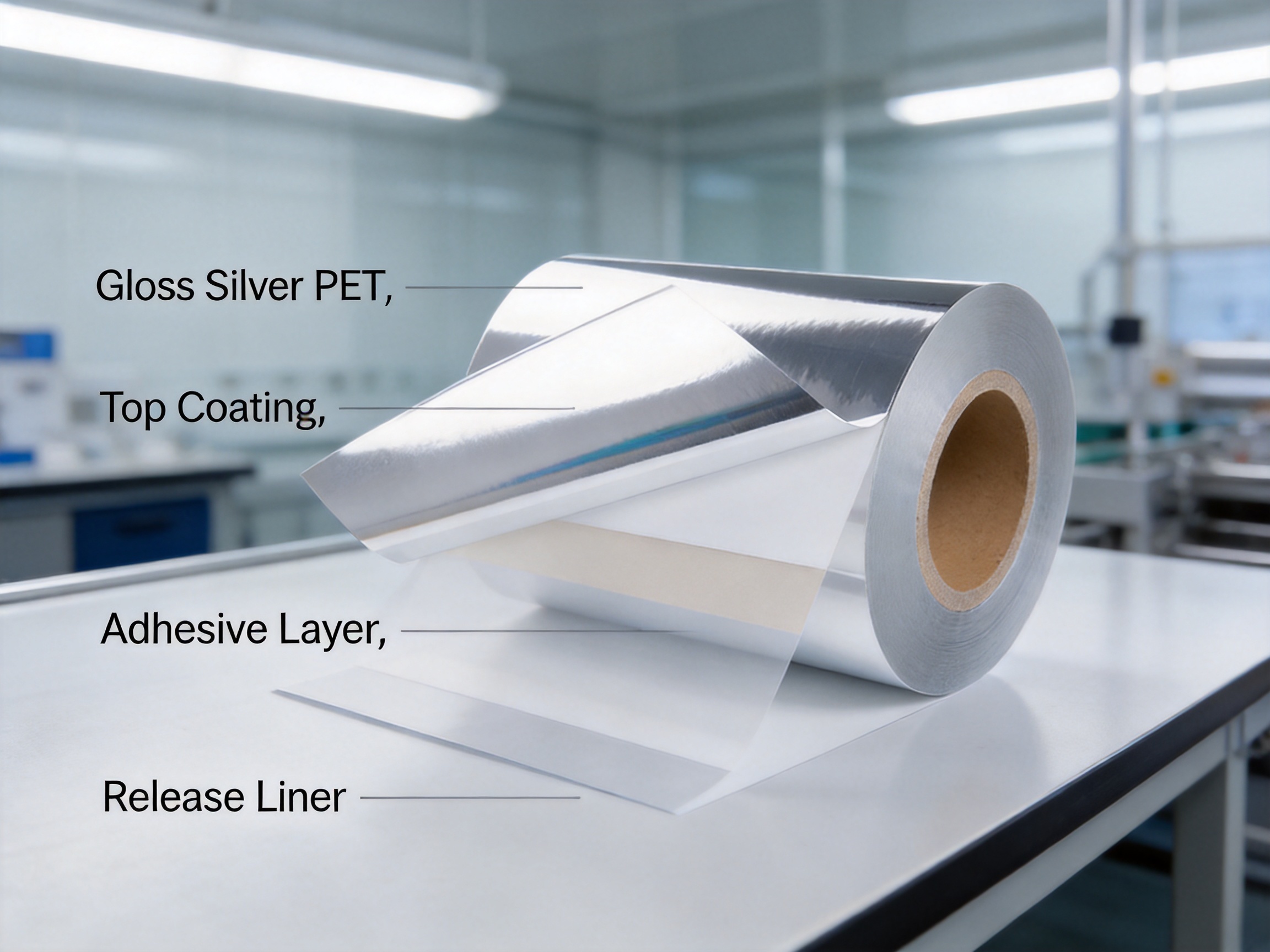
The product structure includes a gloss silver PET face material with coating on top, a pressure-sensitive adhesive layer, and a release liner. The standard face material is 50 mic gloss silver PET with coating on top, while 25 mic, 100 mic, and 150 mic options are available to match different converting, application, and durability requirements. The adhesive system can be selected from water-based adhesive, hotmelt adhesive, solvent adhesive, anti-freeze adhesive, removable adhesive, cryogenic adhesive, and tyre-grade rubber adhesive. The liner options include white glassine paper, release paper, art paper, CCK liner, and transparent PET liner in various grammages or thicknesses.
For label manufacturers, brand owners, packaging engineers, and purchasing teams, this product provides a practical balance of visual appeal, mechanical strength, adhesive flexibility, and production compatibility. It is not only a label surface material but also a complete self-adhesive construction that can be supplied in jumbo rolls, customized rolls, or sheets according to actual production needs.
PaperGloss Silver PET With Coating On Top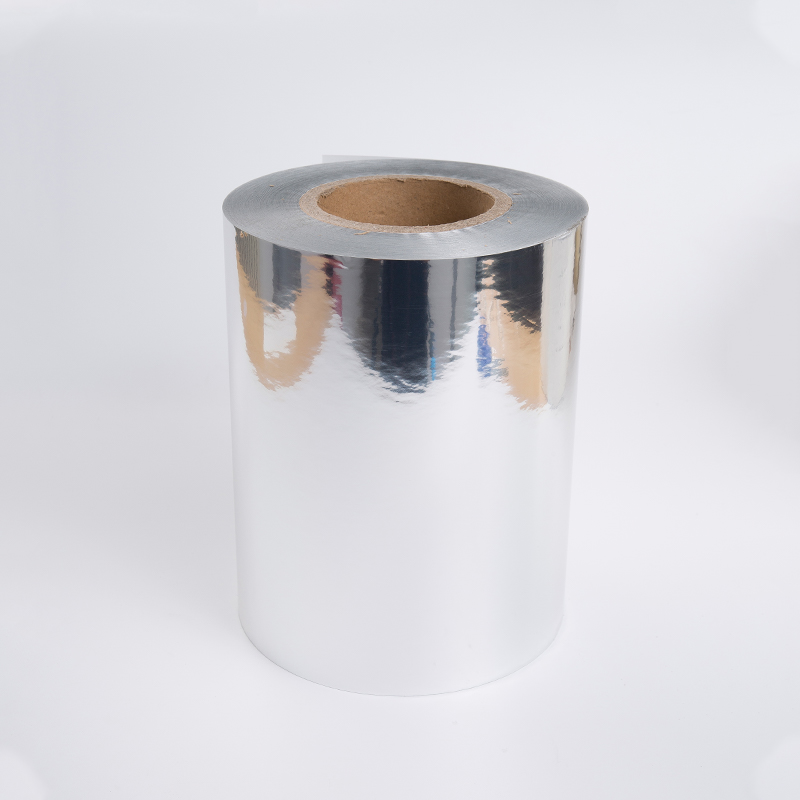
Content
- 1 Product Overview and Core Material Concept
- 2 Key Advantages Over Conventional Label Materials
- 3 Technical Specifications
- 4 Why the Top Coating Matters
- 5 Performance in Waterproof, Oil-Resistant, Chemical-Resistant, and Heat-Resistant Labeling
- 6 Application Fields
- 7 Adhesive Selection and Customization
- 8 Release Liner Options and Their Importance
- 9 Manufacturing Strength and Process Control
- 10 Quality Assurance and Testing Capability
- 11 Customization Through OEM and ODM Capability
- 12 Packaging and Delivery Designed for Material Protection
- 13 Supply Capability and Market Reach
- 14 Sustainability and Responsible Development
- 15 How to Choose the Right Construction
- 16 Competitive Value for Label Converters and Brand Owners
- 17 Practical Handling and Storage Recommendations
- 18 Q&A Section
- 18.1 Q1: What is gloss silver PET with coating on top?
- 18.2 Q2: What is the standard thickness of this product?
- 18.3 Q3: Which adhesive is normally used?
- 18.4 Q4: What kinds of labels can be made from this material?
- 18.5 Q5: Why choose PET instead of paper?
- 18.6 Q6: Can the material be supplied in sheets?
- 18.7 Q7: Can the material be supplied in jumbo rolls?
- 18.8 Q8: What liner options are available?
- 18.9 Q9: Is this material suitable for high-temperature labels?
- 18.10 Q10: Is the material suitable for UL-related applications?
- 18.11 Q11: What makes the manufacturer a strong supplier?
- 18.12 Q12: Can customers request customized constructions?
- 19 Conclusion
- 20 References
- 21 Product: PaperGloss Silver PET With Coating On Top
Product Overview and Core Material Concept
Gloss silver PET self-adhesive label material is built around polyethylene terephthalate film, commonly called PET. PET is widely recognized for its high tensile strength, good dimensional stability, resistance to moisture, and ability to perform in applications where ordinary paper-based materials may fail. When PET is combined with a bright silver finish and a controlled surface coating, it becomes an excellent face material for labels requiring both performance and a premium metallic appearance.
The top coating is an important part of the product. It helps create a uniform printable surface and enhances compatibility with different label printing and converting methods. A metallic PET film without a proper top coating may have limitations in ink anchorage, barcode readability, coating uniformity, or surface handling. The specially prepared coating on this product supports clearer printed graphics, more consistent surface behavior, and improved performance during label production.
The gloss silver surface gives the label a metallic texture, making it especially useful for products that need a clean, high-end, technological, or durable appearance. It can be used for warning labels on electrical devices, specification labels on machinery, decorative labels for cosmetics and jewelry packaging, and identification labels for bathroom products or chemical-resistant packaging. The silver background can communicate quality and reliability while helping the finished label stand out on shelves or equipment surfaces.
The self-adhesive construction allows the material to be die-cut, printed, laminated, slit, sheeted, and applied to various substrates. Depending on the selected adhesive, it can support general-purpose labeling, low-temperature application, removable labeling, freezer or cryogenic use, tyre labeling, or demanding industrial bonding. This flexibility is a major advantage because one face material platform can be adapted to multiple market segments by changing the adhesive and liner combination.
Key Advantages Over Conventional Label Materials
One of the strongest advantages of gloss silver PET label material is tear resistance. Paper labels are cost-effective and suitable for many indoor applications, but they can tear or deform when exposed to moisture, repeated handling, abrasion, or stress. PET film offers superior tear resistance and mechanical strength, allowing labels to survive harsher use conditions. This is especially important for product labels that must remain intact during transportation, storage, installation, and long-term service.
Another major advantage is resistance to water, oil, and many chemical environments. In bathrooms, kitchens, industrial workshops, laboratories, factories, garages, and outdoor handling areas, labels are often exposed to liquid contamination. Paper labels may swell, stain, curl, or lose print clarity. PET film labels are much better suited for these conditions, especially when combined with appropriate inks, coatings, adhesives, and optional protective laminates. This makes the product useful for labels on cosmetics, cleaning products, electronic devices, tools, equipment, and chemical containers.
Heat resistance is also a key benefit. Many labels are applied to devices or components that experience elevated temperatures during operation, storage, transport, or processing. PET material has better thermal stability than many common label papers and some lower-grade films. This helps maintain label shape, appearance, and legibility in applications such as electrical appliances, mechanical products, industrial components, and warning labels. Some related products have passed UL certification, indicating suitability for certain recognized label performance requirements when matched with the correct construction and application conditions.
The gloss silver PET surface provides visual advantages that ordinary white paper or matte films cannot easily achieve. The metallic texture gives labels a premium, technical, and durable impression. For cosmetics, jewelry, high-end packaging, and branded goods, the silver surface can enhance shelf appeal. For electronics and machinery, it provides a professional industrial appearance. For warning and rating labels, it creates a stable background that can support high-contrast printing when properly designed.
Compared with aluminum foil labels, gloss silver PET can provide metallic appearance with better flexibility and film stability in many conversion processes. Aluminum foil may wrinkle or crease more easily under some conditions, while PET film can offer a smoother handling experience during printing, die-cutting, and automatic labeling. PET also provides excellent dimensional stability, which supports accurate registration and consistent die-cutting in high-speed label production.
Technical Specifications
The following table summarizes the key material options and supply formats. Exact construction should be selected according to the customer’s printing method, end-use environment, adhesive performance requirement, and converting equipment.
Item |
Standard Specification |
Available Options |
Face Material |
50 mic gloss silver PET with coating on top |
25 mic, 100 mic, and 150 mic PET options available |
Surface Appearance |
Bright gloss silver metallic finish |
Suitable for premium, industrial, resistant, and decorative labels |
Top Coating |
Uniform functional coating on the PET surface |
Designed to improve printing and converting compatibility |
Adhesive |
Water-based adhesive |
Hotmelt, solvent, anti-freeze, removable, cryogenic, and tyre-grade rubber adhesive available |
Release Liner |
60 g white glassine paper |
50 g, 80 g, 100 g, and 120 g glassine; 60 g, 85 g, 120 g, and 140 g release paper; 140 g and 165 g art paper; 50 g, 80 g, 90 g, and 120 g CCK liner; 25 mic, 36 mic, 50 mic, and 100 mic transparent PET liner |
Jumbo Roll Width |
1000 mm, 1020 mm, 1080 mm, and 1530 mm |
Custom slitting available according to order requirements |
Sheet Size |
A4, A3, 20 x 30, 21 x 30, 24 x 36, 50 cm x 70 cm, and 70 cm x 100 cm |
Customized sheet sizes available |
Packaging |
Sea-transit-worthy poly-wood pallet packing and carton packing |
Roll or sheet packing from stock; 100 sheets per ream; strong PE-coated kraft paper wrapper; stretch film and plastic fastening belt for pallets |
Why the Top Coating Matters
The top coating is one of the defining features of this gloss silver PET material. In label production, the quality of the surface determines how well inks, varnishes, barcodes, and graphics perform. A well-controlled coating can help improve ink wetting, adhesion, print clarity, and resistance to smudging or surface defects. For metallic materials, coating uniformity is especially important because any unevenness may become visible under light reflection.
In practical production, labels may be printed by flexographic, letterpress, screen, offset, thermal transfer, digital, or hybrid methods depending on customer requirements. The top-coated PET surface is intended to support stable printing performance when matched with suitable ink systems and process settings. This can reduce waste caused by poor ink adhesion, uneven color density, surface scratches, or rejected batches.
The coating also supports downstream converting. During die-cutting, matrix stripping, slitting, sheet cutting, and automatic labeling, a stable surface helps preserve the appearance of the label. Metallic gloss materials often reveal defects more easily than matte materials, so surface quality and coating uniformity are important for final product value. A smooth and consistent top coating helps label converters deliver better finished products to brand owners.
For customers comparing this product with ordinary silver films, the coating is a meaningful advantage. Uncoated or poorly coated materials may appear acceptable at first glance but can cause printing problems, inconsistent adhesion of inks, barcode scanning issues, or low resistance to handling. A properly coated face stock gives converters a better platform for consistent production.
Performance in Waterproof, Oil-Resistant, Chemical-Resistant, and Heat-Resistant Labeling
Many labels fail not because the initial appearance is poor, but because the environment is stronger than the material. Water can attack paper fibers. Oils can stain surfaces or soften certain adhesives. Chemicals can damage print layers. Heat can cause shrinking, curling, or adhesive failure. A high-performance label material must be selected as a system, including face material, coating, adhesive, printing ink, and liner.
Gloss silver PET provides a strong foundation for waterproof label applications. Bathroom supplies, shower products, cosmetics, liquid containers, cleaning products, and personal care packaging may be exposed to splashing, humidity, or repeated touching with wet hands. PET film resists water far better than paper, helping the label maintain its dimensional stability and appearance. When combined with suitable printing and adhesive choices, it can deliver durable labels for wet environments.
Oil resistance is important for cosmetics, industrial lubricants, automotive components, mechanical products, kitchen products, and chemical packaging. A PET surface is less absorbent than paper, so it does not take in oil in the same way. This helps preserve the clean look of the label. For applications where oils or solvents are frequently present, additional testing is recommended to select the right ink, varnish, laminate, and adhesive combination.
Chemical corrosion resistance is a valuable property for industrial labels, warning labels, laboratory labels, and product identification labels. The product content notes excellent chemical corrosion resistance, making the material suitable for many resistant label applications. While no single label material can resist every chemical under every condition, PET-based labels are widely used where better resistance is required than ordinary paper can provide.
Heat resistance expands the range of possible applications. Electrical appliances, mechanical equipment, motors, tools, power supplies, control panels, and industrial components may generate or encounter heat. PET film can remain more stable than many alternatives under elevated temperature exposure. For demanding certifications or regulated uses, the final label construction should be tested under the exact conditions of use, including substrate, temperature, dwell time, adhesive, and printing system.
Application Fields
This material is suitable for a wide range of label applications across consumer, commercial, and industrial sectors. Its combination of metallic gloss, strong film structure, and resistance properties makes it valuable wherever appearance and durability must be achieved at the same time.
Electrical Appliances and Electronic Products
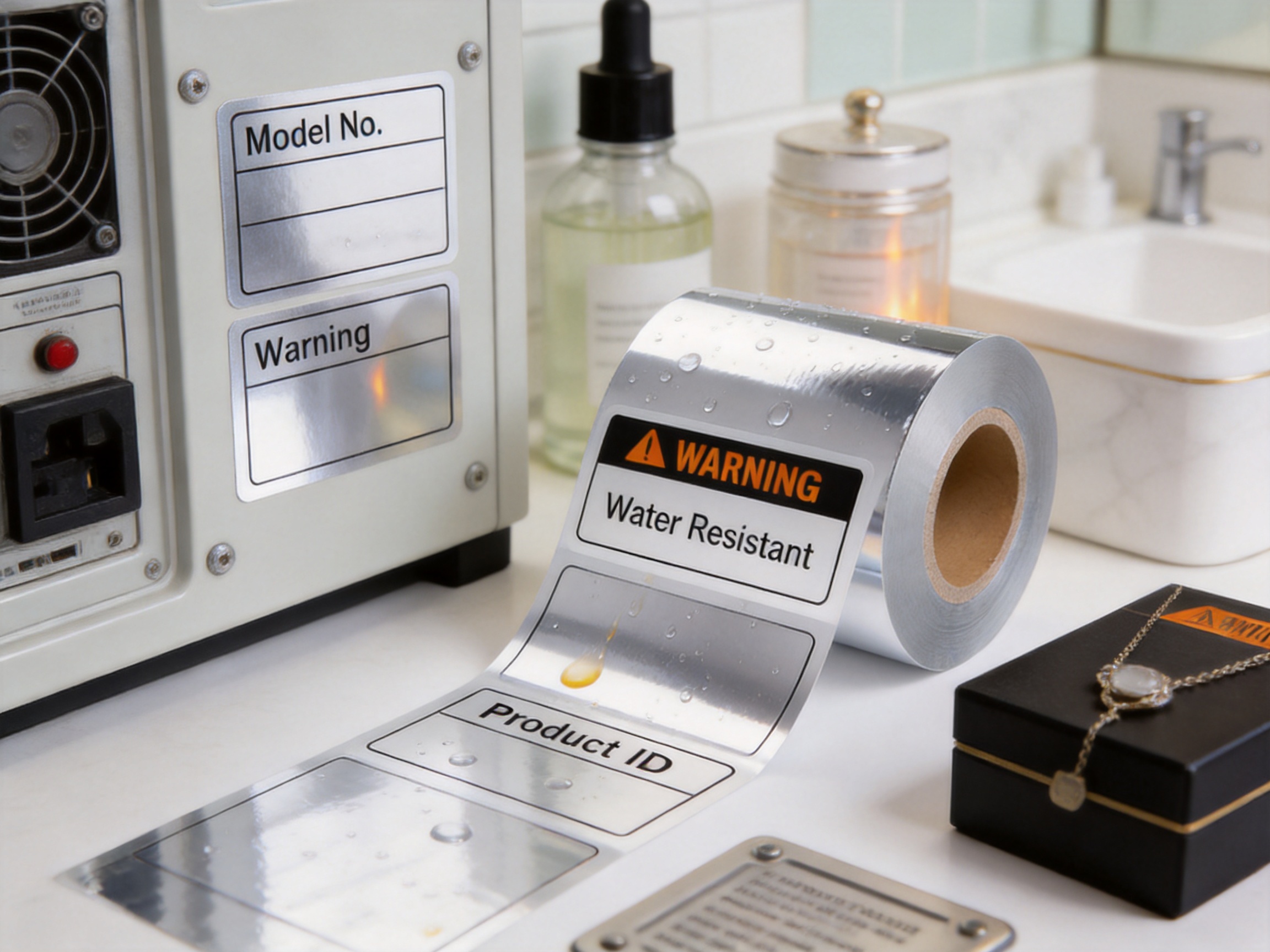
Electrical products often require labels that carry rating information, safety warnings, serial numbers, barcodes, model names, compliance data, and operating instructions. These labels may be exposed to heat, handling, cleaning, abrasion, and long-term aging. Gloss silver PET label material is a strong candidate because it provides a professional metallic look and resists tearing and deformation. It is suitable for appliances, power adapters, control panels, device housings, batteries, electronic modules, and industrial electronics.
Mechanical Products and Industrial Equipment
Machinery labels must remain readable even when exposed to vibration, oil, dust, temperature changes, and rough handling. PET labels can provide stronger durability than paper-based alternatives. The silver surface is also compatible with industrial design language, giving equipment labels a clean and technical appearance. Typical uses include nameplates, warning labels, maintenance labels, equipment identification labels, operating labels, and inventory tracking labels.
Cosmetics and Personal Care Packaging
Cosmetic packaging often requires labels that are both attractive and resistant to moisture, oils, creams, alcohol-based formulations, and frequent handling. Gloss silver PET provides a premium decorative effect, making it suitable for luxury packaging, cosmetic bottles, skincare containers, perfume packaging, and personal care products. The bright metallic surface can support elegant graphic designs and high-value branding.
Bathroom Supplies and Wet Environment Products
Labels used on bathroom supplies may face water, steam, shampoo, soap, cleaning agents, and humidity. Paper labels can wrinkle, peel, or become stained in these environments. PET film labels provide better moisture resistance and can maintain a neat appearance. This makes the material suitable for shower products, bathroom accessories, cleaning products, sanitary goods, and containers stored in damp environments.
Jewelry, Gifts, and Decorative Packaging
For jewelry and gift packaging, label appearance plays a major role in perceived value. The gloss silver surface offers a metallic texture that can create a premium effect. It can be used for brand labels, decorative seals, product tags, promotional labels, and packaging accents. Compared with plain white labels, gloss silver PET can create stronger visual impact and a more refined presentation.
Resistant Labels for Special Environments
Because the product supports multiple adhesive options, it can be adapted for low-temperature, anti-freeze, cryogenic, removable, and tyre-grade applications. This allows label converters to use the same general material concept for very different end-use conditions. For example, a removable adhesive may be selected for temporary identification, while a tyre-grade rubber adhesive may be used for rough and difficult surfaces. A cryogenic adhesive may be used for labels exposed to extremely low temperatures when properly tested.
Adhesive Selection and Customization
The adhesive layer is critical to final label performance. Even the best PET face material will not perform properly if the adhesive is not suitable for the substrate, environment, and application method. This product can be supplied with a variety of adhesive systems, allowing customers to choose the construction that fits their needs.
Water-based adhesive is a commonly used option for many general-purpose self-adhesive labels. It can provide balanced performance for standard applications and is suitable for many packaging and product labeling needs. It is often selected where stable coating, environmental consideration, and broad usability are important.
Hotmelt adhesive can provide strong initial tack and is useful for applications where fast bonding is needed. It may be selected for packaging lines, rougher surfaces, or conditions requiring aggressive initial adhesion. The exact formulation should be matched with the intended substrate and service temperature.
Solvent adhesive is often used when higher resistance or bonding performance is required. It can be suitable for certain demanding applications involving temperature, moisture, chemicals, or long-term durability. For industrial labels and durable goods, solvent adhesive may be considered when performance requirements exceed general-purpose adhesive capabilities.
Anti-freeze adhesive and cryogenic adhesive are designed for cold environments. Products stored, transported, or used under low-temperature conditions require adhesives that remain functional rather than becoming brittle or losing bond strength. These adhesives are relevant for cold-chain logistics, frozen products, laboratory labels, medical storage, and special industrial uses.
Removable adhesive is useful when labels must be removed without leaving heavy residue or damaging the substrate. This can be important for temporary identification, promotional labels, reusable containers, inspection labels, and controlled logistics labels. The removability should always be tested on the actual substrate because surface texture, coating, and aging can influence removal behavior.
Tyre-grade rubber adhesive is designed for difficult rubber surfaces such as tyres. Tyre labeling is challenging because tyre surfaces are rough, curved, low-energy, and may contain release agents or contaminants. A specialized adhesive can improve bonding performance in this difficult application area.
Release Liner Options and Their Importance
The release liner may appear to be only a carrier, but it has a major influence on converting efficiency, die-cutting stability, dispensing behavior, automatic labeling, and roll quality. The product can be supplied with several liner types, including glassine paper, release paper, art paper, CCK liner, and transparent PET liner.
Glassine paper is commonly used in self-adhesive label materials because it provides good smoothness, consistent thickness, and reliable die-cutting performance. A 60 g white glassine liner is the standard option, while 50 g, 80 g, 100 g, and 120 g glassine options are available for different stiffness, release, and converting needs.
Release paper options from 60 g to 140 g can be selected for applications requiring different liner strength, release characteristics, or sheet handling performance. Art paper liners of 140 g and 165 g may be useful where higher stiffness or sheet stability is required.
CCK liner, or clay-coated kraft liner, is available in 50 g, 80 g, 90 g, and 120 g options. CCK liners are often selected for stable release behavior and good performance in roll applications. Transparent PET liners from 25 mic to 100 mic are available where film liner strength, clarity, smoothness, or special converting properties are needed.
Choosing the correct liner can improve productivity and reduce waste. For high-speed die-cutting, liner strength and release consistency help prevent breaks and stripping issues. For automatic labeling, liner stiffness and release force affect dispensing accuracy. For sheet products, liner flatness and package stability help maintain good handling.
Manufacturing Strength and Process Control
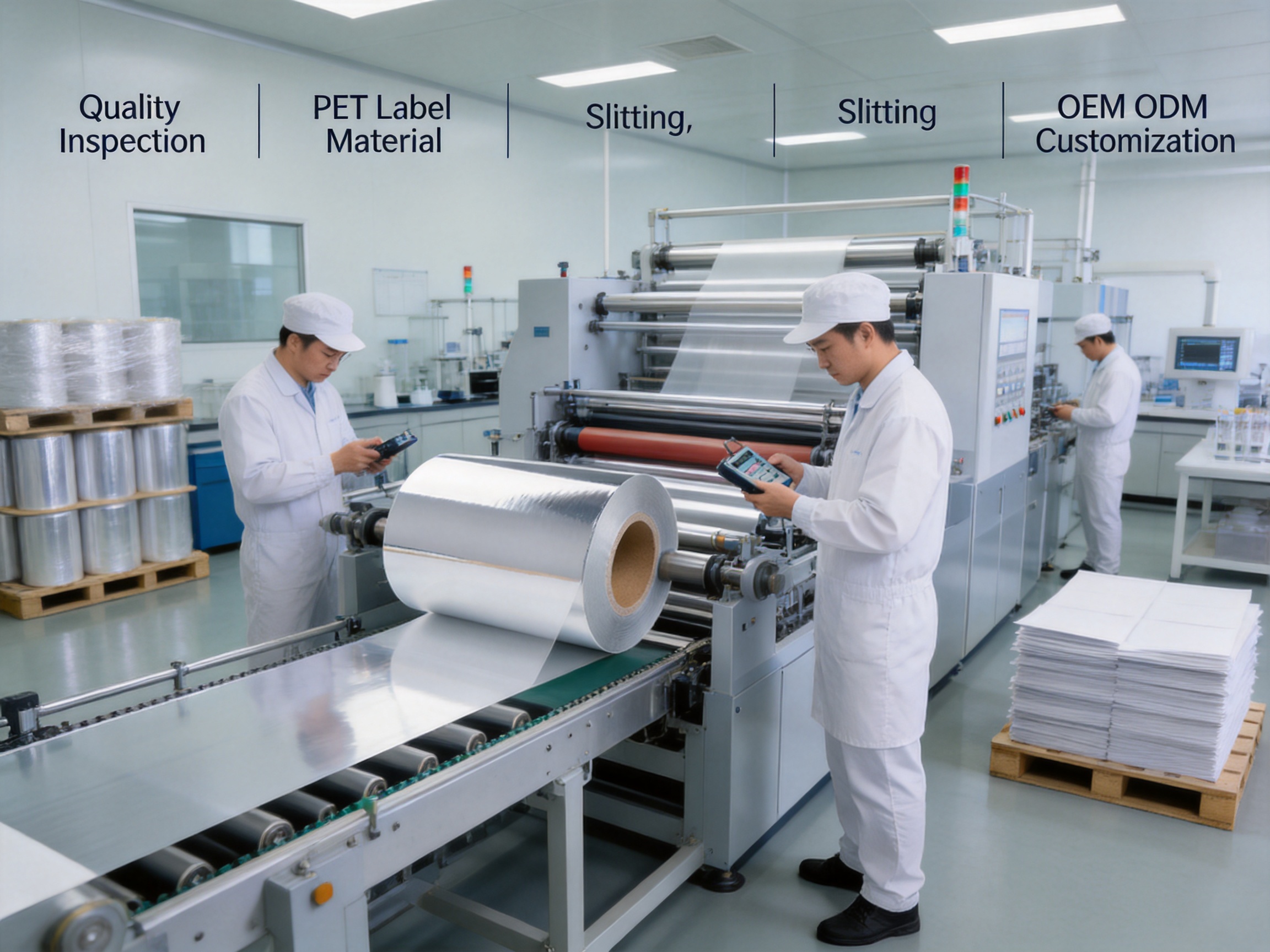
The manufacturer behind this product specializes in high-grade self-adhesive label materials and integrates research and development, production, sales, and after-sales service. This integrated model is valuable because product performance depends on many connected factors: raw material selection, coating technology, adhesive formulation, laminating control, slitting precision, sheet cutting, packaging, inspection, and technical support. When these capabilities are coordinated under one production system, customers can receive more consistent and customized solutions.
Advanced manufacturing lines include gluing, laminating, and cutting processes. The gluing process requires accurate coating weight control, stable adhesive viscosity, proper drying conditions, and clean web handling. For gloss silver PET products, adhesive uniformity is essential because defects can affect both appearance and bonding performance. Controlled coating helps maintain stable peel strength and tack across the roll width and length.
Laminating is the process of combining the coated face material, adhesive layer, and release liner into a stable self-adhesive construction. During lamination, web tension, nip pressure, alignment, surface cleanliness, and temperature conditions must be carefully managed. PET film is dimensionally stable, but metallic gloss surfaces require careful handling to avoid scratches or pressure marks. A controlled laminating process supports smooth roll formation and consistent label conversion.
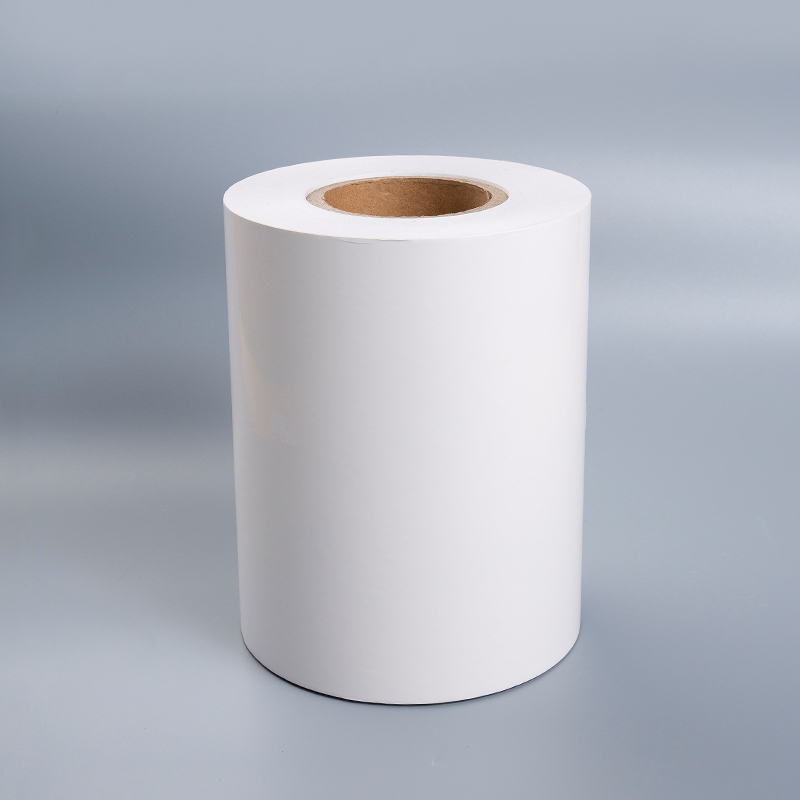
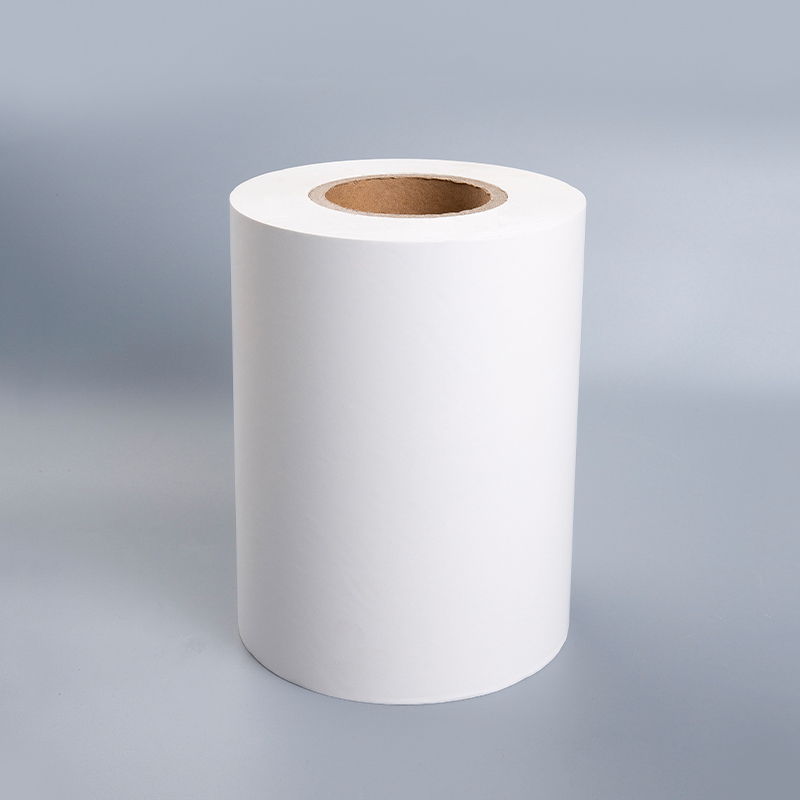
Cutting and slitting are equally important. Jumbo rolls can be supplied in widths of 1000 mm, 1020 mm, 1080 mm, and 1530 mm, then slit into customized widths according to customer requirements. Precision slitting helps converters reduce edge defects, telescoping, adhesive bleeding, roll deformation, and unwinding problems. Sheet cutting is also available for sizes such as A4, A3, 20 x 30, 21 x 30, 24 x 36, 50 cm x 70 cm, 70 cm x 100 cm, and customized sizes.
The company has an annual production capacity of more than 280 million square meters and ranks among the leading self-adhesive product enterprises in China. Large-scale production capacity is not only a matter of volume. It also helps support stable supply, efficient scheduling, broad product variety, and cost competitiveness. For customers with recurring demand, a strong production platform reduces the risk of material shortages and supports long-term procurement planning.
Quality Assurance and Testing Capability
Quality in self-adhesive materials must be verified at multiple stages. A finished label material can look acceptable visually but still fail if the adhesive strength is inconsistent, the release force is unstable, the face material thickness varies, or the surface coating does not match the printing process. For this reason, a manufacturer with its own testing laboratory and advanced inspection equipment has a clear advantage.
Testing may include thickness measurement, coating weight control, peel adhesion, tack, release force, shear strength, dimensional stability, surface appearance inspection, printing compatibility checks, temperature resistance, aging performance, and packaging inspection. For PET label materials used in electrical, mechanical, chemical, and cosmetic fields, these tests help ensure the material is suitable for its intended purpose.
The company’s quality manufacturing concept has been developed through more than 20 years of experience. Long-term manufacturing experience is important because self-adhesive materials involve both science and practical production knowledge. Different adhesives behave differently under changing humidity, temperature, coating speed, drying conditions, and liner types. Experienced technical teams can identify potential risks and recommend appropriate constructions before customers encounter problems in production.
Some products have passed UL certification, which is significant for applications involving durable labels and electrical or electronic products. UL-recognized label materials are often required where labels must remain attached and legible under specified safety-related conditions. Customers should confirm the exact certified construction and application conditions when UL-related performance is required, but the availability of UL-tested product lines demonstrates strong technical capability.
Customization Through OEM and ODM Capability
Different customers require different label materials. A cosmetic brand may need a premium silver appearance and excellent surface finish. An electronics manufacturer may require barcode durability and heat resistance. A tyre label converter may need aggressive adhesion to rubber. A logistics company may need removable identification labels. A laboratory supplier may need cryogenic performance. These requirements cannot all be served by one fixed construction.
The company offers OEM and ODM services based on customer drawings, samples, or application requirements. This allows customers to request changes in face material thickness, adhesive type, liner type, roll width, sheet size, release force, packaging method, and other specifications. Customization is especially valuable for label converters who serve multiple end markets and need reliable material partners that can adjust product structures quickly.
A professional research and development team with multiple patents supports continued product innovation. In self-adhesive material manufacturing, innovation may involve adhesive formulation, coating technology, liner release control, environmentally responsible material selection, improved printing compatibility, and specialty label constructions for difficult environments. Strong ODM capability allows the manufacturer to work with customers not only as a supplier, but also as a technical development partner.
Packaging and Delivery Designed for Material Protection
High-performance label materials must arrive in good condition. A gloss silver PET surface can be sensitive to scratches, dents, pressure marks, dust, and improper storage conditions. Packaging therefore plays an important role in preserving product value during transportation, especially for international sea transit.
Sea-transit-worthy poly-wood pallet packing and carton packing are available for rolls or sheets from stock. For sheet products, 100 sheets per ream can be packed with strong PE-coated kraft paper wrappers. Strong pallets are wrapped with stretch film and fastened with plastic fastening belts. This packaging system helps protect against moisture, movement, edge damage, and handling stress during storage and transport.
For roll materials, proper palletization, wrapping, and fastening help maintain roll shape and reduce the risk of telescoping, crushing, or contamination. For sheet materials, ream packing helps maintain flatness and cleanliness. Customers who require special packaging, labeling, pallet size, export markings, or handling instructions can discuss customized packing solutions based on shipping method and destination.
Supply Capability and Market Reach
A reliable material supplier must provide not only product quality but also stable supply and responsive service. The company has built sales outlets across major domestic markets and has developed an international marketing network covering countries and regions in Asia, Europe, the Americas, Africa, the Middle East, and other areas. This global experience is useful for customers who need export-ready materials, international packaging standards, and communication across different market requirements.
Long-term stable supplier relationships are built through consistent quality, predictable delivery, technical support, and problem-solving ability. For label converters and brand owners, switching material suppliers frequently can create risks, including color variation, adhesive changes, die-cutting differences, print quality changes, and customer approval delays. A supplier with broad production capacity and established market experience helps reduce these risks.
The company’s more than 20 years of OEM manufacturing experience also supports professional collaboration. Customers can provide samples, technical drawings, target performance requirements, or end-use conditions, and the technical team can recommend suitable constructions. This is particularly important for specialty materials such as gloss silver PET with top coating, where face material, coating, adhesive, and liner must work together.
Sustainability and Responsible Development
Modern label material selection increasingly includes sustainability considerations. Customers are not only asking whether a label performs well, but also whether the supplier is working toward more responsible material solutions. The company’s brand positioning emphasizes sustainable development and environmental protection, including eco-friendly solutions involving face materials, adhesives, and backing papers.
In self-adhesive label materials, sustainability can be improved in multiple ways. Water-based adhesives may reduce reliance on certain solvent systems in appropriate applications. More efficient coating and slitting can reduce production waste. Stable quality can reduce rejected materials during printing and converting. Customized construction can prevent over-engineering, allowing customers to choose the right thickness and liner instead of using excessive material. Better durability can also reduce product relabeling and replacement waste.
For PET materials, responsible use means selecting them for applications where their durability provides real value. A high-performance PET label is especially appropriate when paper labels would fail and require replacement, or when safety, product identification, and long-term readability are important. Matching the material to the application is one of the most practical forms of sustainability because it avoids both premature failure and unnecessary material consumption.
How to Choose the Right Construction
When selecting gloss silver PET label material, the first step is to define the application environment. Will the label be used indoors or outdoors? Will it be exposed to water, oil, chemicals, heat, cold, abrasion, or UV light? Will the label be applied to plastic, metal, glass, coated paper, rubber, painted surfaces, or curved containers? Each condition influences the best adhesive and liner choice.
The second step is to identify the printing method. Different printing technologies require different surface compatibility, ink systems, and drying or curing conditions. The top coating improves printability, but testing is still recommended before mass production. If barcodes, QR codes, serial numbers, or small text are required, print clarity and contrast should be verified on the silver surface.
The third step is to choose the face material thickness. A 50 mic gloss silver PET construction is a balanced option for many durable label applications. A 25 mic option may be selected where thinner labels, flexibility, or reduced material thickness are important. Thicker 100 mic or 150 mic PET may be chosen for labels requiring more stiffness, stronger handling, or a more substantial feel.
The fourth step is adhesive selection. For normal applications, water-based adhesive may be appropriate. For aggressive bonding, hotmelt or solvent adhesive may be considered. For low-temperature use, anti-freeze or cryogenic adhesive should be evaluated. For temporary applications, removable adhesive may be selected. For tyres or difficult rubber surfaces, tyre-grade rubber adhesive should be tested.
The fifth step is liner selection. Roll label converters may prefer glassine or CCK liners depending on equipment and die-cutting needs. Sheet users may require stronger paper liners or art paper liners for flatness and handling. Transparent PET liners may be useful for special converting, clarity, or high-performance dispensing requirements.
Finally, customers should conduct application testing before full-scale production. Testing should include actual substrate, application temperature, dwell time, environmental exposure, printing system, die-cutting process, and packaging conditions. This ensures the selected material performs reliably in real-world use rather than only under laboratory conditions.
Competitive Value for Label Converters and Brand Owners
For label converters, this product offers strong commercial value because it supports multiple end-use industries with one adaptable material platform. The same gloss silver PET face material can be paired with different adhesives and liners, allowing converters to respond to customer requests across cosmetics, electronics, machinery, bathroom products, jewelry, chemical products, and specialty resistant labels. This reduces sourcing complexity and supports faster project development.
For brand owners, the value lies in the combination of appearance and durability. A label is often the first visible expression of product quality. If a label wrinkles, peels, stains, or tears, customers may doubt the product itself. Gloss silver PET labels can help preserve a premium appearance and maintain product information over time. In regulated or safety-related applications, durable labels also help protect compliance and user safety.
Compared with competitors offering only standard paper labels or basic film labels, this material provides a stronger performance profile. It offers metallic gloss, tear resistance, heat resistance, moisture resistance, chemical resistance, adhesive flexibility, liner variety, custom sizes, and production support from an experienced manufacturer. The result is a product that can help customers reduce failure risks, improve label appearance, and expand into higher-value applications.
Practical Handling and Storage Recommendations
To preserve material performance, rolls and sheets should be stored in a clean, dry, and temperature-controlled environment. Excessive humidity, direct sunlight, high temperature, dust, and pressure damage should be avoided. Materials should remain in original packaging until use to prevent contamination or surface scratches.
Before printing or converting, the material should be conditioned to the production environment when necessary. Sudden temperature or humidity changes can influence curl, static, adhesive behavior, and print performance. Operators should use clean handling procedures, especially because gloss silver surfaces can show fingerprints, scratches, or dust more visibly than matte white materials.
During die-cutting, blade sharpness, die pressure, web tension, and liner selection should be optimized. PET film is stronger than paper, so tooling and process parameters may need adjustment. Excessive die pressure can damage the liner, while insufficient pressure can leave incomplete cuts. Proper testing helps achieve clean edges and efficient matrix stripping.
During application, the substrate surface should be clean, dry, and free from oil, dust, release agents, and loose particles. Pressure-sensitive adhesive requires sufficient application pressure to develop contact with the substrate. Bond strength typically increases after dwell time, so immediate peel testing may not represent final adhesion. For low-temperature or difficult surfaces, adhesive choice and application conditions are especially important.
Q&A Section
Q1: What is gloss silver PET with coating on top?
It is a self-adhesive label face material made from gloss silver polyester film with a functional top coating. The coating improves the surface for printing and converting, while the PET film provides strength, dimensional stability, moisture resistance, and a metallic appearance.
Q2: What is the standard thickness of this product?
The standard material is 50 mic gloss silver PET with coating on top. Other available face material thicknesses include 25 mic, 100 mic, and 150 mic, allowing customers to choose the proper stiffness, flexibility, and durability level.
Q3: Which adhesive is normally used?
Water-based adhesive is a standard option. Depending on the application, hotmelt adhesive, solvent adhesive, anti-freeze adhesive, removable adhesive, cryogenic adhesive, and tyre-grade rubber adhesive are also available.
Q4: What kinds of labels can be made from this material?
It can be used for waterproof labels, oil-resistant labels, chemical-resistant labels, high-temperature resistant labels, electrical appliance labels, mechanical product labels, cosmetic labels, jewelry packaging labels, bathroom supply labels, warning labels, rating labels, and other durable product identification labels.
Q5: Why choose PET instead of paper?
PET provides better tear resistance, moisture resistance, dimensional stability, and durability than ordinary paper. It is better suited for applications where labels are exposed to water, oil, heat, chemicals, or heavy handling.
Q6: Can the material be supplied in sheets?
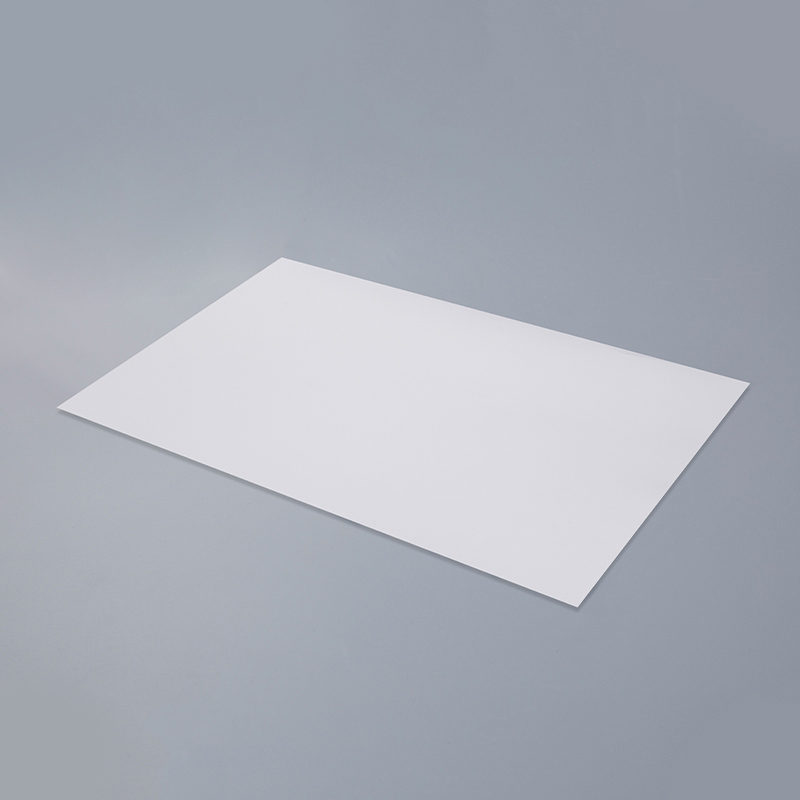
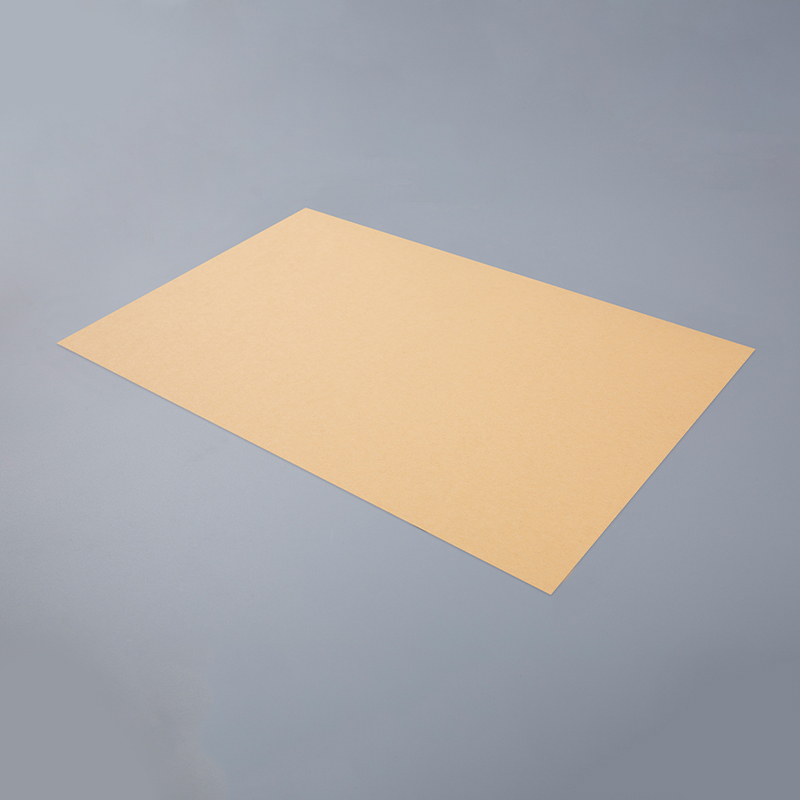
Yes. Sheet sizes include A4, A3, 20 x 30, 21 x 30, 24 x 36, 50 cm x 70 cm, and 70 cm x 100 cm. Customized sheet sizes are also available according to customer needs.
Q7: Can the material be supplied in jumbo rolls?
Yes. Jumbo roll widths include 1000 mm, 1020 mm, 1080 mm, and 1530 mm. Custom slitting can be arranged based on converting equipment and order requirements.
Q8: What liner options are available?
Available liners include white glassine paper, release paper, art paper, CCK liner, and transparent PET liner in multiple grammages or thicknesses. The correct liner should be selected according to die-cutting, dispensing, sheet handling, and labeling requirements.
Q9: Is this material suitable for high-temperature labels?
Yes, PET has good thermal stability compared with many ordinary label materials, and the product is suitable for many high-performance label applications. For critical uses, customers should test the exact construction under the actual temperature and exposure conditions.
Some related products have passed UL certification. Customers requiring UL performance should confirm the exact certified construction, adhesive, substrate, printing system, and application conditions before production.
Q11: What makes the manufacturer a strong supplier?
The manufacturer integrates research and development, production, sales, and after-sales service. It has gluing, laminating, and cutting production lines, more than 280 million square meters of annual production capacity, an internal testing laboratory, advanced inspection equipment, more than 20 years of OEM manufacturing experience, and strong OEM and ODM capability.
Q12: Can customers request customized constructions?
Yes. Customers can request customized face material thickness, adhesive type, liner type, roll width, sheet size, packaging method, and other specifications. Samples, drawings, or application requirements can be used to develop suitable constructions.
Conclusion
Gloss silver PET self-adhesive label material with coating on top is a high-value solution for customers who need durable labels with a bright metallic appearance. Its PET film base delivers excellent tear resistance, dimensional stability, moisture resistance, heat resistance, and chemical resistance. Its uniform top coating supports improved printing and converting performance. Its flexible adhesive and liner options allow the material to be adapted for general-purpose, industrial, low-temperature, removable, cryogenic, and tyre-labeling applications.
Compared with standard paper labels and ordinary uncoated film labels, this product offers a stronger combination of durability, appearance, and customization. It is suitable for labels used in bathroom supplies, cosmetics, jewelry, electrical appliances, mechanical products, chemical-resistant packaging, waterproof applications, oil-resistant applications, and high-performance product identification.
The manufacturer’s integrated production capability, advanced gluing and laminating processes, precision cutting, large annual capacity, testing laboratory, OEM and ODM experience, and commitment to sustainable development provide customers with more than a material supply. They provide a reliable technical partnership for long-term label material development. For converters and brand owners seeking a metallic, durable, and customizable label material platform, gloss silver PET with coating on top is a practical and competitive choice.
References
Bibliography Entry 1: Pressure-Sensitive Adhesive Technology and Applications, Industry Technical Review.
Bibliography Entry 2: Polyester Film Properties for Durable Label Materials, Materials Engineering Handbook.
Bibliography Entry 3: Label Converting Process Control for Filmic Face Stocks, Packaging Production Guide.
Bibliography Entry 4: Durable Label Performance in Moisture, Chemical, and Heat Exposure, Industrial Labeling Standards Review.
Bibliography Entry 5: Release Liner Selection for Pressure-Sensitive Label Converting, Adhesive Materials Technical Manual.